September 27, 2023
Between March and July 2023, Julia Horn and Gerd Leipold interviewed 27 representatives of sociopolitical actors (from trade unions, works councils, churches, social and welfare associations, environmental organizations and the climate movement, five from academia and think tanks, three from networks and foundations).
On June 22, 22 an online discussion workshop was held with ten of the interviewees and five additional guests from other socio-political fields. Topics of discussion were the discrepancy between leadership and members of an organization and "climate money" as a financial instrument in climate policy, with expert input.
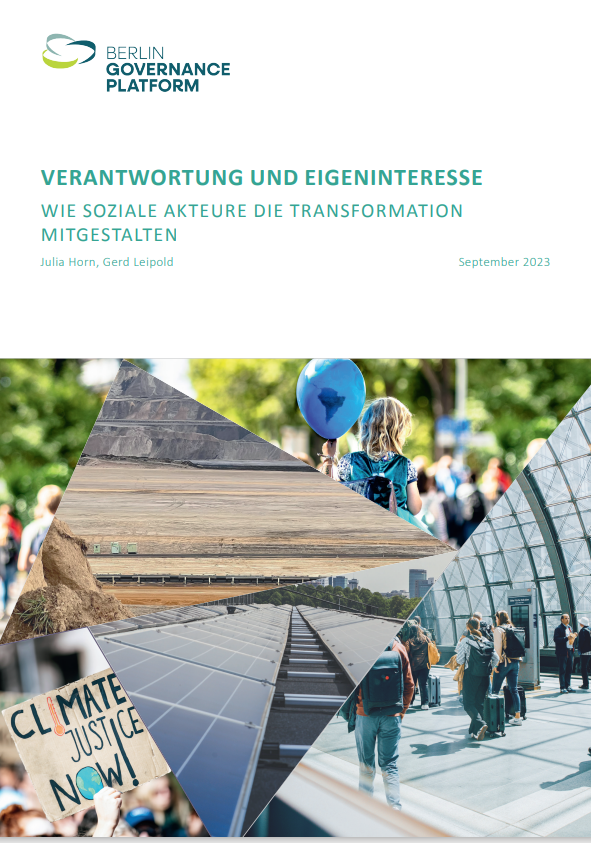
Based on the interviews and the discussion workshop, a summary report was prepared and has now been published. The final report includes the main findings of the interviews, quotes and examples and contains recommendations of the authors for the engagement of socio-political actors in climate policy.
There was great interest in the topic of "climate money" as a financial compensation mechanism in the discussion round. Although it is in the coalition agreement, a climate money has not yet been launched by the government. There is a lot of half-knowledge and also misunderstanding about what a climate money should and should not do. For example, a flat-rate climate fee paid per capita is not intended to have a steering effect; this is already provided by the CO2 price. The purpose of such a climate money is only to compensate for additional costs that arise due to price increases as a result of a CO2 price.
At the EU level, a social climate fund was recently adopted. This fund, worth 86.7 billion euros, is intended to cushion higher costs. 5 billion of this will flow to Germany. To implement the fund at national level, Germany must submit a social climate plan by mid-2025. Prior to this, mandatory stakeholder consultations must take place. A "good practice" exchange between EU member states is planned for the first half of 2024.
The upcoming design of the EU Climate Social Fund at the German level is an opportunity forsocial actors to proactively shape the process. Until now, stakeholders have often come on the scene as supplicants after the fact and demanded social cushioning. The EU obliges member states to conduct stakeholder consultations. These can be used to involve stakeholders at an early stage and to offer them room for maneuver.
Are you working on similar topics? Do you have feedback or ideas? We look forward to hearing from you! You can also learn more about the project here.