The European Integration and Development Fund

Ein progressiver Ansatz für europäische Solidarität

Municipalities that agree to take in asylum seekers should be strengthened with a financial incentive. To this end, we propose the establishment of an EU fund to which municipalities can apply directly for financial resources. Beyond the costs of reception and integration, municipalities can receive funds in the same amount for their own municipal development.

Logo European Integration and Development Fund for Municipalities

Project overview

Cities and municipalities are central actors in the reception of migrants and protection seekers. They are responsible for providing housing, integrating them into the local labor market, and providing social services such as healthcare, childcare, and education. At the same time, they are notoriously underfunded and excluded from most EU decisions on asylum and migration policy. Yet, in recent years, many municipalities across Europe have declared their willingness to voluntarily receive additional migrants and refugees and have shown their willingness to participate in Euroepan relocation from Europe's external borders. Although municipalities do not have the legal authority to directly participate in relocation programs, their willingness to host refugees could be used to break the political deadlock at the European level. To do so, they need to be supported with adequate resources by the European Union, among other things.

European funding for welcoming municipalities

As a way to support voluntary reception by municipalities, we propose the establishment of an independent European "Integration and Development Fund" from which municipalities could receive reimbursement for reception costs and the same amount for their own municipal development. Such an innovative combination of integration and community development measures would provide municipalities with adequate funding and transform the reception of refugees from a financial burden into an opportunity for sustainable development at the local level. This fund can give cities an incentive and greater leeway to engage in humanitarian, sustainable, and inclusive solutions. Especially in times of rising anti-migration sentiment and the reluctance of EU member states to engage in intra-European refugee redistribution programs, this municipal approach offers a new perspective for progressive European solidarity.

Legal opinion

However, the joint financing of urban development and integration in a common fund and the direct transfer of EU funds to municipalities and cities raises legal and practical questions. Do the EU treaties allow for such a fund? And how must it be designed to be a useful and accessible instrument for both large and small cities and municipalities? To discuss these legal and practical challenges and possibilities, we have commissioned a legal opinion together with the Friedrich Ebert Foundation and discussed it with European actors and legal experts.

Policy Brief

There are also limited opportunities for cities and municipalities to apply for direct EU funding for reception and integration costs. However, the procedure is often complex and the effort for municipalities is very high. In a policy brief, we provide an overview of the various EU funding mechanisms in this area.

DURATION

2020 - 2022

TEAM
PARTNER

Friedrich Ebert Foundation Brussels

KONTAKT NACH PROJEKTENDE

Publications

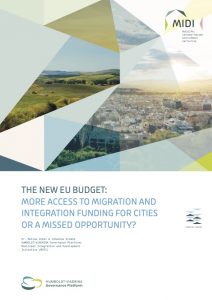
Municipalities in Europe are bearing direct responsibility in migrant 
and refugee reception and integration. Yet, they are notoriously short 
on funding and continue to be precluded from most EU decisions on asylum
 and migration policy. This policy brief sheds light on the 
complexities, burdens, and prospects of access to EU funding for 
municipalities for reception and integration costs. We provide an 
overview of different EU funding mechanisms in the field, the basic 
modes of operation of the funds and the contentious debates surrounding 
the current 2021-2027 EU budget. Given the ongoing deficiencies 
regarding municipalities’ access to and involvement in the programming 
of funds, we close the policy brief with some recomendations.
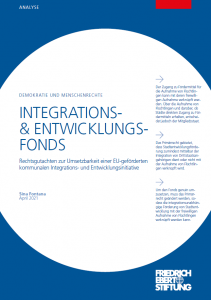
A screenshot of the title of the legal opinion "Integration and Development Fund". In the European Union, refugee policy lacks a medium- and long-term strategy that supports actors in the EU who are willing to receive and integrate refugees. This includes in particular the municipalities, which have not been sufficiently considered as independent actors so far. In order not to see the reception of refugees as a burden, but rather to use it as an opportunity for sustainable development, we propose that the EU should establish an independent "Integration and Development Fund". From this, municipalities participating in a relocation program of protection seekers from Europe's external borders could directly receive funds for the reception and integration of refugees. Under our proposal, they would also receive the same amount of funds for their own municipal development projects. From the perspective of Union law, the first question is whether a competence of the European Union to establish such a fund can be derived from primary law. The legal opinion examines precisely this question.
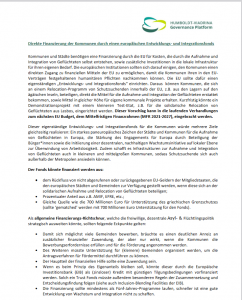
A screenshot of the homepage of the short concept "Direct financing of municipalities through a European development and integration fund". Europe should strengthen the voluntary reception of refugees by cities and municipalities with an investment initiative. Additional funding should allow municipalities more room for maneuver. Those municipalities that are willing to take in refugees should be reimbursed for the costs of reception and integration directly from a European development and integration fund. The municipalities that want to take on more responsibility would thus have the financial means to do so. As an additional incentive, they should receive funds in the same amount for their own municipal development. In this way, the cities and communities could experience a revitalization not only economically, but also culturally, since, for example, funds would be available for cultural projects.  This concept outlines how such a fund could be financed.

Further projects on the topic of migration

  • Impact Cities

    Impact Cities vernetzt Städte und zivilgesellschaftliche Akteur:innen aus Europa, um gemeinsam neue Ansätze für eine solidarische und menschenrechtsbasierte Aufnahme und Integration von Schutzsuchenden zu entwickeln.
  • Logo und eine Kommune des Pojekts Re:MatchJob der Berlin Governance Platform in vier Farben. Die jeweiligen EInzelstücke des Symbols matchen mit den anderen zusammen und ergeben ein passendes Ganzes.

    Re:MatchJob

    Re:MatchJob erprobt datenbasierte Matching-Ansätze, um Schutzsuchende und Städte passgenauer zusammenzubringen und nachhaltige Arbeitsmarktintegration zu fördern.
  • Logo und eine Kommune des Pilotprojekts Re:Match der Berlin Governance Platform in vier Farben. Die jeweiligen Einzelstücke des Symbols matchen mit den anderen zusammen und ergeben ein passendes Ganzes.

    Re:Match

    Re:Match pilotiert datenbasiertes Matching von Schutzsuchenden und Städten für partizipative Relocation. Das bedarfsorientierte und individualisierte Matching mithilfe eines Algorithmus in aufnahmebereite Kommunen ist ein innovativer Lösungsbeitrag für eine menschenrechtsbasierte europäische […]
  • Offering refugees a home in Berlin

    How can refugees find adequate and affordable housing in Berlin? In the midst of a tight housing market and numerous barriers to access, we are developing ideas for possible solutions with policymakers, civil society and the real estate industry.
  • CERV Project Cities4Refugees

    Cities4Refugees

    Cities4Refugees ist ein Projektkonsortium aus den solidarischen europäischen Städten Berlin, Villeurbanne und Zagreb sowie den NGOs Berlin Governance Platform, BBAG und Studio Rizoma. Das zweijährige Projekt hat das Ziel, eine strategische […]
  • From the Sea to the City

    From The Sea To The City (FSTC) is a European civil society network consisting of several NGOs and political grassroots initiatives. Together, we engage the European public through innovative [...]
  • Photo of participants of the trialogue "Nutrition, Health and Social Cohesion

    Trialogue Series Social Cohesion

    As part of BUA's "Grand Challenge Social Cohesion" initiative, the three-part trialogue series "Social Cohesion" was held in late summer and fall 2022. The focus was on the transdisciplinary exchange of 6 Exploration Projects [...]
  • This header image shows a symbol for networking in the colors of the Berlin Governance Platform over a picture of a municipality. The project for this is in the area of migration and is called Networks for a Welcoming Europe.

    Networks for a Welcoming Europe

    In a map, actors and networks in the field of migration in Europe were identified and networked, and strategic partnerships were established.
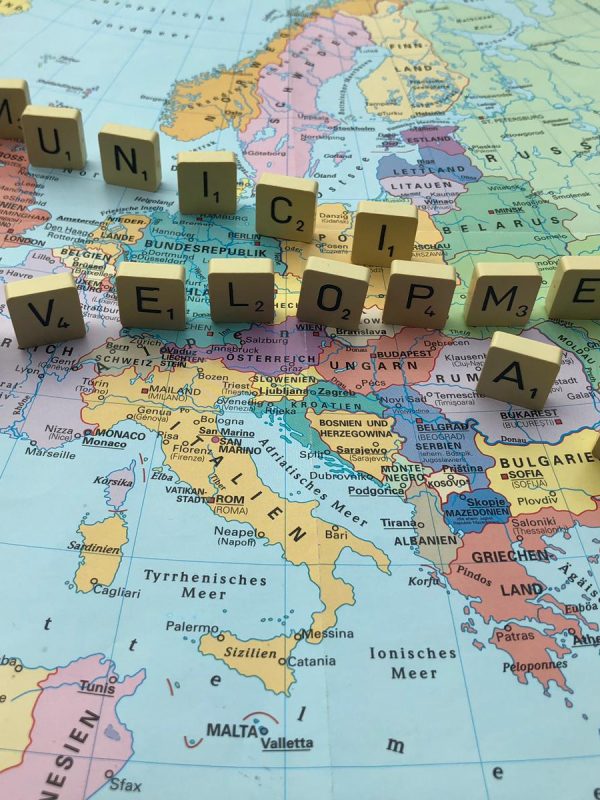
  • On a map of Europe, tokens are placed on which "Municipal Development" can be read. The project Municipal Integration and Development Initiative in the Migration Sector of the Berlin Governance Platform developed several concepts and projects in this regard.

    Municipal Integration and Development Initiative

    The Municipal Integration and Development Initiative (MIDI) starts at the local level and develops governance concepts in which municipalities play a central role. A joint, participatory shaping of municipal development [...]
  • The European Integration and Development Fund

    Municipalities that agree to take in asylum seekers should be strengthened with a financial incentive. For this purpose, we propose the establishment of an EU fund to which the municipalities can directly apply for financial resources [...]